
CT Examiner 8/26/2026
STONINGTON — Advances in water testing for DNA have upended a two-decade-old conversation about water quality and Wequetequock Cove, sparking public outrage over what some residents see as a lack of effort by local government to address extraordinarily high levels of human fecal contamination in the water.
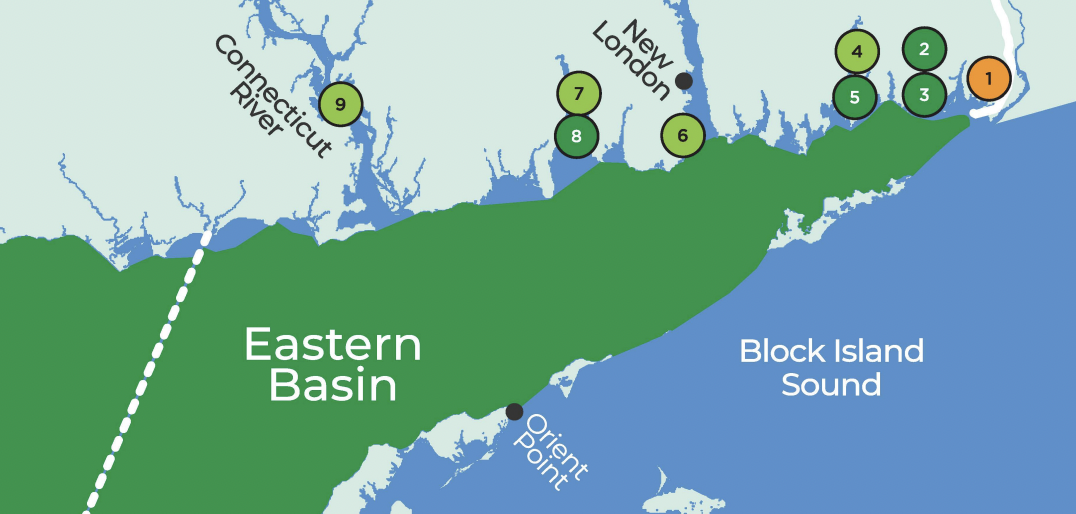
The statewide environmental nonprofit Save the Sound, for years, has given Wequetequock Cove’s water quality the lowest rating in the eastern part of the state.
But until recently, according to Paul Goetz, no one was quite sure whether the pollution was from nearby farms, geese or humans. That changed in 2022, when DNA testing was able to narrow the source of the pollution to human waste.
Goetz, who has a longtime family connection to the cove, owns Stonington Marina and helped organize the Wequetequock Clean Water Coalition to deal with the problem – reaching out to local elected officials, Ledge Light Health District, and state officials – and finding willing partners with Stonington-based Clean Up Sound and Harbors and Save the Sound.
On Monday, Goetz decided to take those efforts public and invited CT Examiner to review the tests and maps, and offered a tour of the village to show what he says are the main sources of the problem.
In the workshop of his marina, he compared historic maps of the area, with extensive wetlands, to postwar development which he believes is a significant source of the contamination. He gave a tour of a nearby drainage drainage ditch flowing directly into the cove that has tested extraordinarily high for human fecal contamination
DNA tests performed by Clean Up Sound and Harbors turned up high levels of human fecal coliform in surface runoff, the cove and in wells.

Those quieter efforts and letters went public on Wednesday, when dozens of residents surprised town leaders, packing a Board of Selectmen meeting, and voicing concerns about human fecal contamination of the water in the quaint waterside village along the Boston Post Road.
Roger Reynolds, the senior legal director for Save the Sound, told CT Examiner the tests point to failing septic systems in Wequetequock, where many of the houses were built on filled wetlands or have older systems.
Reynolds, who attended the meeting, urged town officials to take responsibility for solving the problem.
“When it’s a big problem like this, it’s called a community pollution problem, and it’s not only the responsibility of individual parties … but the community, meaning the Town of Stonington, has direct responsibility to deal with it,” Reynolds told CT Examiner.
Reynolds said the discharge of improperly treated septic is a clear violation of local, state, and federal environmental and public health laws.
But on Wednesday night Goetz put the onus on local leaders.
“Bottom line is our community health safeguards are failing, and we have a problem in the water, and we can’t count on Ledge Light or DPH, and we’re really urging our local government to be a galvanizing force to get these other entities react and get the safeguards back in place today,” Goetz said.

James Jehoda described to members of the Board of Selectmen the decline in water quality that he had witnessed over the past 60 years.
“The water was clean. There were food crabs everywhere, and fast forward to today, you do not see them,” he said, urging local officials to clean up the cove.
Cheryl Davis said her neighbor’s well has tested positive for e-coli in the drinking water.
“That should concern all of us as residents of the town,” she said. “I may not have it in my water now, but I may in the future.”
Caitlyn Serra, who brought her two children along with her at the meeting, said as a parent the water quality issue makes her uneasy.
“This is a place that the children of Stonington are spending time, and as a parent, it makes me very nervous,” she said.
Steve Gumpel said he wished town officials were more “excited” to address the issue.
“If Stonington Harbor was getting turned upside down in a similar fashion, we would be there for you,” he said.
Stephen McCabe questioned why town officials have known about this issue for four years, but have not acted.
First Selectmen Bill Middleton said that claim was “not true.”
Middleton, who told CT Examiner he first became aware of the problem around the time he took office in late 2025, said the town has been conducting water testing around the area, and that the Water Pollution Control Authority will be embarking on sewer study, which will look at the possibility of putting sewers in Wequetequock Cove.

Town water testing records, which were provided to CT Examiner through a public records request, show that Stonington has tested the cove as recently as in mid-August. These results also detected human fecal coliform in the water.
Middleton said the local WPCA had estimated the cost of extending sewers into the neighborhood at about $10 million.
But some questioned if sewers were the best option to deal with the issue.
“Everybody can agree that we want clean water. There’s no doubt. I don’t know if sewers are the answer,” one resident said, adding that a planned condo development in the area was shot down years ago over sewers.
“Be careful what you wish for,” he said.

Middleton told CT Examiner after the meeting that the town is testing the water to narrow down the sources of the pollution.
“I think we’re going to find that it’s very few sources that are contributing the majority of the issue,” Middleton said.
He said that the town does not have oversight of failing septics. Middleton said it was a problem for the Ledge Light Health District.

A spokesperson for the Department of Energy and Environmental Protection agreed, in an email to CT Examiner, that septic issues were under the jurisdiction of the regional health district.
But according to Goetz, Ledge Light had shown little interest in the issue.
Contacted by CT Examiner for comment, Ledge Light Health District did not respond, and previously failed to respond to a query regarding benzene and xylene polluting groundwater in Old Lyme.
Middleton, who was elected in 2025, said a solution would take time.
“This problem didn’t appear overnight, and it won’t get solved overnight,” Middleton said, adding that the solution to the issue is a “giant undertaking.”
“That’s just the pace of these things,” Middleton said. “I’m sorry.”
Still, residents are looking for solutions.
“What matters is this is our community,” said Davis. “We pay taxes in the community, and I would want clean water for my neighbor.”
