Save the Sound 5/1/2026
Program has collected water quality data from Long Island Sound bays and harbors since 2017
The 10th season of the Unified Water Study (UWS) got underway Friday morning, with Save the Sound and 30 partner organizations ready to collect water quality samples in 52 bays and harbors around Long Island Sound during the 2026 monitoring season.
Launched by Save the Sound in 2017 to better understand water quality in the Sound’s bays and harbors, the Unified Water Study standardized monitoring procedures, protocols, and equipment used to collect data on a range of parameters, including dissolved oxygen, Chlorophyll a, turbidity (water clarity), macrophytes (seaweed), and oxygen saturation. Having access to comparable data collected around the Sound helps paint a picture of the ecological health of the Sound’s bays and harbors and how well they can support aquatic life and healthy marine habitats.
“We believe in the model of data-to-understanding-to-action, and the Unified Water Study standardized the ways these data are collected in local bays and harbors,” said Peter Linderoth, director of Healthy Waters and Lands at Save the Sound, who managed the development of the UWS with partners and has coordinated the program since its launch. “With years of reliable data, we can make apples-to-apples comparisons of water quality conditions in bays and harbors around the Sound. That helps us understand the water quality challenges an embayment may be facing, which leads local decision-makers to determine the best potential solutions to restore and protect it.”
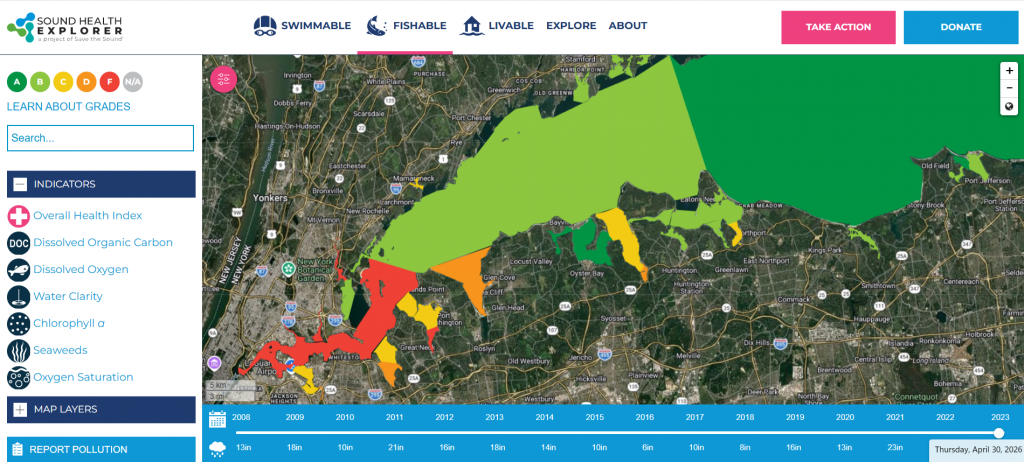
Save the Sound uses the data to create Bay Grades, which are published and shared in its biennial Long Island Sound Report Card. In the 2024 Report Card, 42 percent of the 57 bay segments monitored in 2023 received a C, D, or F grade. Only 11 (19 percent) received an A. The 2026 Long Island Sound Report Card will be released in September, featuring grades based on data collected in the 2025 monitoring season.
“Each bay along the Connecticut and New York shorelines is unique, differing in their depth, shape, the condition of the stormwater, tributaries, and groundwater that flow into them, and their proximity to the waters of the open Sound,” said Linderoth. “Their challenges are also unique, as each embayment receives different percentages of nitrogen pollution from multiple sources, whether that’s onsite septic systems, wastewater treatment plant effluent, lawn fertilizer, combined sewer overflows in the more urbanized areas, or stormwater runoff.”
The UWS season runs from May 1 through October 31; groups conduct biweekly monitoring days over the course of the six-month season, with all sampling events to occur within three hours of sunrise.
Here are the groups participating in the 2026 UWS (original participants in bold) and the sites they sample:
| Ash Creek Conservation Association | Bridgeport Harbor |
| Avalon Nature Preserve | Stony Brook Harbor |
| Bridgeport Regional Aquaculture Science and Technology Education Center | Black Rock Harbor |
| Bronx River Alliance | Bronx River |
| Citizen Science Learning Center | Goldsmith Inlet |
| Clean Up Sound and Harbors | Wequetequock Cove, Mystic River, Mystic Harbor |
| Coalition To Save Hempstead Harbor | Hempstead Harbor |
| Connecticut River Conservancy | Connecticut River |
| Cornell Cooperative Extension of Suffolk Co. Marine Program | Lloyd Harbor, Huntington Harbor, Huntington Bay, Centerport Harbor, Northport Harbor, Northport Bay |
| East Basin Enterprises LLC | Milton Harbor, Mamaroneck Harbor, Larchmont Harbor |
| Fishers Island Seagrass Management Coalition | West Harbor |
| Friends of the Bay | Mill Neck Creek, Oyster Bay, Cold Spring Harbor |
| Friends of the Farm River Estuary | Farm River |
| Guardians of Flushing Bay | Flushing Bay |
| Harbor Watch | Norwalk Harbor (Inner & Middle), Saugatuck River, Five Mile River |
| Interstate Environmental Commission | Little Neck Bay, Manhasset Bay |
| New England Science & Sailing | Stonington Harbor |
| Project Oceanology | Mumford Cove, Poquonnock River |
| Remote Ecologist | Alewife Cove |
| River Advocates of South Central Connecticut | New Haven Harbor |
| Roger Tory Peterson Estuary Center | Black Hall River |
| Salonga Wetlands Advocate Network | Nissequogue River |
| Save the River — Save the Hills | Niantic River |
| Save the Sound | New Rochelle Harbor, Hunter Island Bay, Eastchester Bay |
| Setauket Harbor Task Force | Port Jefferson Harbor |
| SoundWaters | Holly Pond, Stamford Harbor |
| SUNY Maritime | Westchester Creek |
| The Maritime Aquarium at Norwalk | Norwalk Harbor (Outer) |
| Town of Darien | Scott Cove, Darien Harbor, Cove Harbor |
| Town of Fairfield Conservation Department | Mill River (Southport Harbor) |
| Town of Stratford Conservation Department | Housatonic River |
“We thank all of the groups that participate in the Unified Water Study, and all the passionate individuals who are working toward a common goal of understanding and improving water quality in Long Island Sound,” said Emily Bulmer, environmental analyst at Save the Sound, who coordinates the UWS monitoring groups. “This program would not be possible without all of the dedicated partners.”
Data collection for the Unified Water Study is funded by the Environmental Protection Agency’s Long Island Sound Partnership. Science Advisors to the UWS are Jamie Vaudrey, PhD, and Jason Krumholz, PhD.
QUOTES FROM OTHER ORGANIZATIONS THAT HAVE PARTICIPATED SINCE 2017:
Mary Donato, Research and Education Director at Harbor Watch: “The existence of comparable data is crucial for understanding the health of the waters feeding the Sound. With so many groups doing amazing separate work for many years, the ability to get everyone under the same protocol is great for knowing where priorities and resources for improving water quality are needed, and how strategies implemented in the past continue to have positive impacts. For Harbor Watch, participating in the Unified Water Study was a natural fit from the beginning. We have been able to continue and expand our monitoring of local harbors, connect with other organizations, and be on the forefront of data collection and action for the Long Island Sound watershed.”
Fran Pijar, Co-Chair Water Quality, Clean Up Sound and Harbors: “Joining the Long Island Sound Unified Water Study provided CUSH with the opportunity to expand our water sampling activity to a new embayment (Mystic Harbor), as well as publish our results to a broader community. We were also able to use the biennial Long Island Sound Report Card as a basis for a local Report Card for southeastern Connecticut estuaries.”
Michelle Lapinel McAllister, Programs Director, Coalition to Save Hempstead Harbor: “The Coalition to Save Hempstead Harbor has been an enthusiastic partner in the Unified Water Study since its pilot year, selected in part due to our longstanding commitment to water quality monitoring in Hempstead Harbor since 1992. The strength of the UWS lies in its region-wide approach—transcending municipal boundaries to provide a broader understanding of environmental conditions and trends. CSHH is honored to be part of this collaborative effort and remains committed to advancing the protection and restoration of our shared waters for future generations.”
Bill Cavers, Darien Advisory Commission on Coastal Waters: “Darien has been a participant in the Unified Water Study from the start and Save the Sound’s training and staff support have been invaluable all along the way. The program importantly draws the town’s and residents’ attention to water quality in our harbors and along our beautiful shorelines. Last year, we held the first annual public presentation of our data. Attendance and interest were high. All this greatly helps us to increase local awareness and care for the health of Darien’s watershed and coastal waters.”
Nicki Rosenfeld, Director, Vessel Operations & Programs, The Maritime Aquarium at Norwalk: “Participating in the Unified Water Study has allowed us to know our harbor more deeply: going out sampling at sunrise typically captures the lowest dissolved oxygen levels of the day which can otherwise be masked as the day goes on. Bays and harbors—where rivers meet the Sound—are important areas to both marine life and to us, and collecting this data helps tell a more complete picture of water quality across Long Island Sound.”
Christine Suter, Executive Director, Friends of the Bay: “We feel privileged to have been one of the original groups chosen to participate in the Unified Water Study and to have been able to continue with it and expand our efforts in the program over the last five years. The Long Island Sound Report Card has become a valuable tool for us to share with our followers. From the data we collect they can see how the health of our bays and harbors and compares to others throughout Long Island Sound.”
